Volcanoes National Park covers 160 square kilometres of Afromontane and bamboo forest across the Virunga volcanic chain in north-western Rwanda. Gazetted in 1925 as a protected reserve for mountain gorillas, it is Rwanda's oldest national park and one of the most consequential conservation areas in Africa. The park encompasses five of the eight Virunga volcanoes within Rwanda's borders: Karisimbi at 4,507 metres; Muhabura at 4,127 metres; Bisoke at 3,711 metres; Sabyinyo at 3,669 metres; and Gahinga at 3,474 metres. It forms part of the wider Virunga Conservation Area, which extends into Virunga National Park in the Democratic Republic of Congo and Mgahinga Gorilla National Park in Uganda.
The park's reputation rests on a single species. Mountain gorillas exist nowhere else in the world outside the Virunga massif and Bwindi Impenetrable National Park in Uganda; together these areas hold the entire global population. Rwanda's share of that population lives here, in forest between roughly 2,400 and 4,500 metres. What distinguishes Volcanoes from comparable gorilla destinations is logistics: the park is two to three hours from Kigali by road; trekking groups are well-organised; and Rwanda's infrastructure and security record make access straightforward. The cost of a single permit is the highest in the region, but the experience that permit unlocks is one that cannot be replicated anywhere else on the continent.
This guide covers the decisions involved in planning a visit: when to go; what wildlife to expect; current permit and activity fees; accommodation across budget levels; Rwanda's visa requirements; what to pack; and how to get there.
Best time to visit
Volcanoes National Park can be visited throughout the year; gorilla trekking is not suspended during the wet season. The choice of when to go is about trail conditions and physical comfort rather than access. The park sits at high altitude; temperatures are cool to cold year-round, and rain can fall in any month. The relevant distinction is between the two dry seasons, when trails are firmer and hiking is generally easier, and the two wet seasons, when conditions underfoot are muddier and progress through the bamboo forest is slower.
The dry season from June to September is the most popular period. Trails are at their most accessible; the forest is navigable without the deep mud that characterises the wet months; and clear mornings offer the best conditions for viewing the volcanoes from lodge terraces and ridgeline paths. July and August see the highest visitor numbers, coinciding with northern hemisphere summer travel. September combines good conditions with Kwita Izina, Rwanda's annual baby gorilla naming ceremony, which is held each year in early September at the foothills of Volcanoes National Park in Kinigi. The 2026 edition is confirmed for 4 September.
The second dry season from December to February is shorter but equally productive for trekking. January is a particularly good month: conditions are comparable to the June to September peak with noticeably fewer visitors. Some repeat visitors consider it the best single month to be in the park.
Regardless of season, mornings at this altitude are cool and often misty. Temperatures at the trailhead range from around 10 to 15 degrees Celsius at dawn, rising to between 18 and 22 degrees by mid-morning on clear days before clouds return. Clothing that can be layered and removed is more practical than fixed warm weather or cold weather gear. Rain should be anticipated in every month of the year; a waterproof jacket is non-negotiable on any packing list.
What wildlife to expect
Mountain gorillas are the primary draw and the reason most visitors make the journey. The park currently has 12 habituated gorilla families; all 12 are open to standard trekking tourism, with each group visited by a maximum of eight people per day, giving a total of 96 permits issued daily. Additional gorilla groups within the park are habituated for scientific research only and are not accessible to tourists. Rwanda's gorilla population represents approximately one-third of the world's total mountain gorilla count; the global figure across all habitats stood at over 1,000 individuals as of the most recent census, a number that has grown steadily over two decades of protected management.
The trek to locate a gorilla family takes anywhere from 30 minutes to five or six hours depending on where the group has moved overnight. Once the trackers locate the family, visitors have exactly one hour with them at a minimum distance of seven metres. In practice the gorillas often move closer; infants in particular show little awareness of the rule. The permitted hour is enforced strictly; rangers time it from the moment of first contact. Camera flash is prohibited throughout.
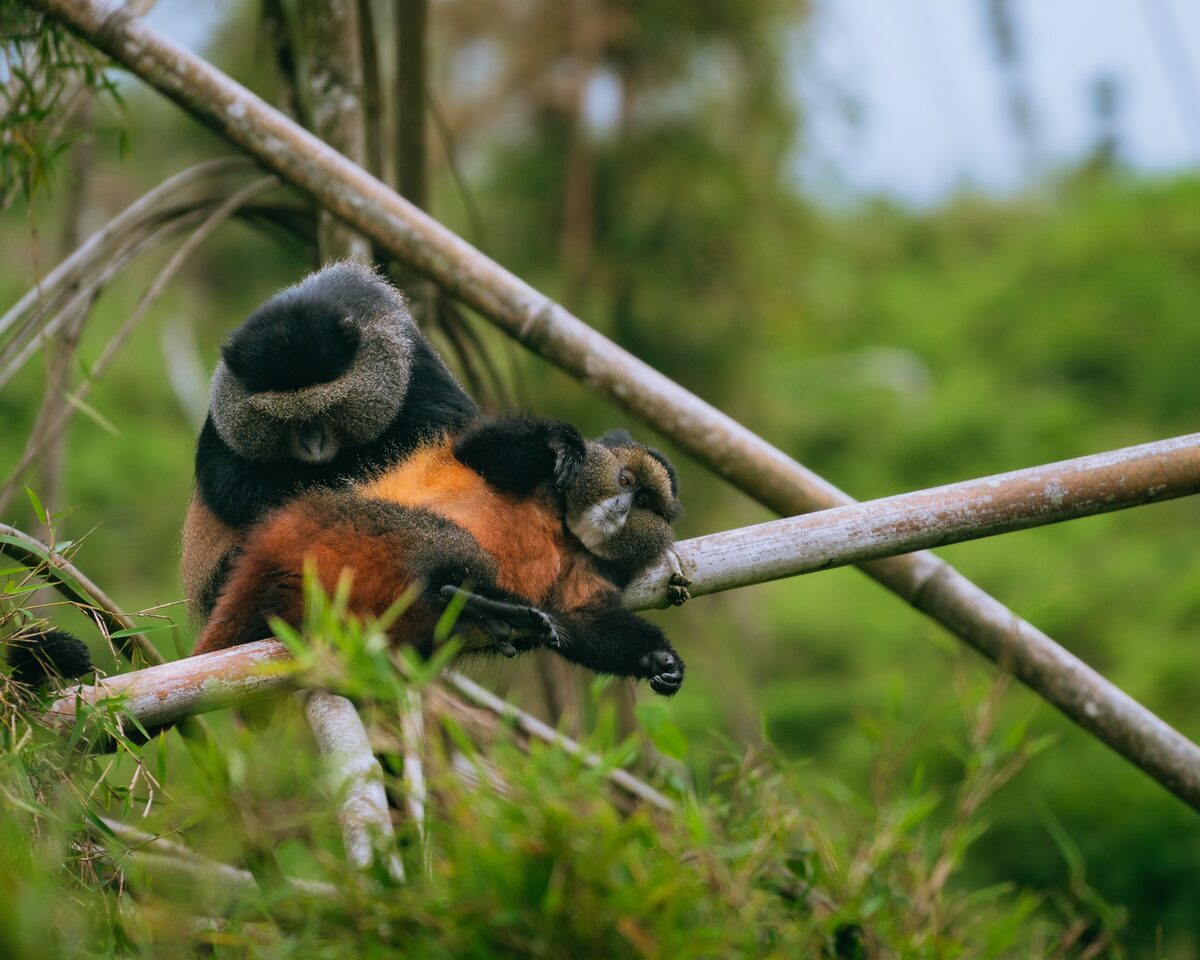
Golden monkeys are the park's second major primate attraction and are exclusively found in the Virunga ecosystem; Volcanoes National Park and Mgahinga Gorilla National Park in Uganda are the only places in the world where they can be tracked. The golden monkey is a subspecies of the blue monkey distinguished by its vivid orange and gold coat and its preference for bamboo zones at lower elevations within the park. Tracking permits cost USD 100 for international visitors, a fraction of the gorilla permit, and the experience takes two to four hours. Groups can be large and the monkeys are active and fast-moving; it is an energetic contrast to the measured hour with the gorillas and complements the gorilla trek well as a second-day activity.
Beyond the two flagship primate experiences, the park holds forest elephants, buffalo, spotted hyena, black-fronted duiker, bushbuck and black-and-white colobus monkeys. These species are present but encounters are not reliable and should not be planned for. The park's birdlife is more predictable: 178 species have been recorded, including at least 29 endemic to the Rwenzori mountains and the Virunga region. Notable species include the Rwenzori turaco, Grauer's rush warbler and the handsome francolin. Birding is best in the transitional and wet season months when migrant species supplement the resident population.
Activities beyond gorilla trekking
Gorilla trekking drives the majority of visits but the park has a broader activity menu that rewards visitors who stay for three or more nights.
Mount Bisoke is the most accessible of the park's five volcanic summits and the standard choice for a day hike. The trail ascends through hagenia and hypericum forest before opening onto moorland below the summit at 3,711 metres. The reward at the top is a perfectly circular crater lake; on a clear morning the views extend across the Virunga chain. The hike takes approximately five to six hours return and is rated moderately challenging; it does not require technical experience but demands reasonable fitness. The permit costs USD 75 for international visitors and a ranger guide accompanies each group.
Mount Karisimbi, at 4,507 metres the highest point in the Virunga chain and the highest peak in Rwanda, is a two-day overnight hike with camping on the mountain. The summit views on a clear morning stretch across Rwanda, Uganda and the Democratic Republic of Congo. The permit costs USD 400 for international visitors; porters are strongly recommended and charged separately. This is a demanding high-altitude hike and is suited to fit, experienced trekkers.
The hike to Dian Fossey's grave at the ruins of the Karisoke Research Centre is one of the most historically resonant experiences in East African conservation. Fossey established Karisoke between Mounts Karisimbi and Bisoke in September 1967 and worked there until her murder in 1985. She is buried next to her favourite silverback, Digit, at the site. The hike takes three to four hours return and passes through the forest she spent two decades documenting. The permit costs USD 75 for international visitors.
The Gorilla Guardians' Village near the park entrance, formerly known as the Iby'iwacu Cultural Village, is a community tourism project made up of reformed poachers and local community members who now participate in conservation and cultural exchange. Visitors can watch traditional dance and music performances, hear stories from former poachers about their transition to conservation work, and learn about traditional Rwandan practices. It is among the more authentic cultural tourism experiences in the region and is worth including if time allows.
How long to stay
Two nights is the practical minimum for a visit centred on gorilla trekking. This gives one full day for the trek itself and a second morning for golden monkey tracking or a shorter volcano hike before departing. The pace is workable but does not leave much margin: a demanding gorilla trek that takes six hours leaves little energy for anything else that day.
Three nights is a better baseline. With three nights, it is possible to complete gorilla trekking on day one; golden monkey tracking and a cultural village visit on day two; and a Bisoke hike or a more relaxed departure morning on day three. This pace reflects how the park is best experienced: the gorilla trek is the centrepiece, but the other activities add context and depth to what would otherwise be a very short visit to a remarkable landscape.
Many visitors combine Volcanoes National Park with Akagera National Park in the east for Big Five game drives; with Nyungwe Forest National Park in the south-west for chimpanzee tracking and canopy walks; or with Uganda's Bwindi Impenetrable National Park for a cross-border primate circuit. The three-country East African Tourist Visa, which covers Rwanda, Kenya and Uganda for USD 100 and is valid for 90 days, makes the Uganda combination particularly practical from a logistics perspective.
Entry requirements and visa
Rwanda operates one of the most open visa policies in Africa. Since January 2018, nationals of all countries can obtain a tourist visa on arrival at Kigali International Airport and at all land border crossings. No advance application is required for the on-arrival option; the fee is USD 50 for a single-entry 30-day visa, payable at the point of entry. Those who prefer to apply before travel can do so via the official government portal at irembo.gov.rw, which issues an e-visa within three to five working days for the same cost.
Several categories of visitor are exempt from visa fees entirely. Citizens of countries that are members of the African Union, the Commonwealth of Nations or La Francophonie receive a 30-day visa on arrival at no charge. East African Community nationals, including citizens of Kenya, Uganda, Tanzania, Burundi, South Sudan and the Democratic Republic of Congo, enter free of charge for up to six months. A select group of countries, including Angola, Ghana, Mauritius, Seychelles, Singapore and others, receive 90-day visa-free entry by bilateral arrangement. Citizens of Kenya and Uganda may also use a national identity card in lieu of a passport.
All passports must be valid for at least six months beyond the intended departure date from Rwanda and must have at least one blank visa page available. Yellow fever vaccination certificate is required for travellers arriving from or transiting through a yellow fever endemic country; for travellers arriving directly from Europe, North America or most of southern and eastern Africa, no certificate is required. Rwanda does not currently impose any specific malaria prophylaxis requirement, though the park's high altitude means malaria risk in Volcanoes itself is low; the risk is more relevant for visitors combining the trip with time at lower elevations elsewhere in East Africa.
The East African Tourist Visa is worth knowing about for visitors combining Rwanda with Kenya and Uganda. It costs USD 100 per person and allows multiple entries across all three countries for 90 days. It must be applied for through the first country entered in the itinerary; if the trip begins in Rwanda, the application is made through Rwanda's immigration system before or on arrival.
Gorilla permit fees and activity costs
The gorilla trekking permit is the dominant cost of a Volcanoes National Park visit and is issued by the Rwanda Development Board. As of 2026, the permit costs USD 1,500 per person per trek for international visitors from outside Africa. The fee covers park entry, the guided trek and one hour with a habituated gorilla family. It does not cover porter fees, tips for guides and rangers, accommodation, transport or any other activities. Permits are non-refundable if the holder cancels or does not appear on the day.
Only 96 gorilla trekking permits are issued per day across the 12 habituated families that participate in tourism. This translates to eight visitors per family per day. Demand consistently outpaces supply during peak season months; booking six to twelve months in advance is the standard guidance for June to September visits. December and January permits also book out quickly. For off-peak months from March to May and October to November, booking three to four months in advance is generally sufficient. Permits can be booked directly through the Rwanda Development Board's reservations system or through a licensed tour operator, who will handle the booking as part of a wider safari package.
The minimum age for gorilla trekking is 15 years; this rule is applied consistently across Rwanda, Uganda and the DRC by mutual agreement between all three countries and is not waived under any circumstances.
Other activity fees for international visitors are set by the Rwanda Development Board and include: golden monkey tracking at USD 100 per person; Mount Bisoke hike at USD 75 per person; Dian Fossey grave and Karisoke Research Centre hike at USD 75 per person; Mount Gahinga hike at USD 75 per person; Mount Muhabura hike at USD 100 per person; and Mount Karisimbi two-day hike at USD 400 per person. Camping on Karisimbi costs USD 30 per night for international visitors. Porter hire for any trekking activity costs approximately USD 15 per day and is handled at the park headquarters in Kinigi; porters are local community members and tipping is standard practice.
There is no general admission fee for the park. Entry is governed by activity permits; a visitor must hold a valid permit for at least one activity to enter the park. Permits can be paid through the Rwanda Development Board directly or through a licensed tour operator.
Accommodation options
Budget
Budget accommodation around Volcanoes National Park is concentrated in Musanze, the nearest town, which lies roughly 15 to 20 kilometres from the park entrance at Kinigi. Options include guesthouses and small hotels with basic facilities and straightforward access to park headquarters. Red Rocks Rwanda in Musanze is a well-regarded eco-friendly lodge and cultural centre offering both rooms and camping, with rates at the lower end of the market. Kinigi Guesthouse, closer to the park boundary in the Kinigi district, provides simple accommodation at the base of Mount Sabyinyo. Budget options in this category typically charge between USD 50 and USD 120 per room per night and do not include meals in the standard rate.
Midrange
The midrange tier is the most competitive segment around Volcanoes and includes a range of well-run lodge properties positioned between Musanze and the park entrance. Five Volcanoes Boutique Hotel, with 13 rooms and sweeping views of the Virunga peaks, is one of the most consistently recommended options at this level; it offers warm service, good food and reliable logistics for early-morning park departures. Mountain Gorilla View Lodge, a long-established property with 30 rooms set in individual chalets above a working valley, provides comparable facilities and reliable volcano views. Le Bambou Gorilla Lodge, just outside the park entrance, is another option offering comfortable rooms in a garden setting. Midrange properties in this category typically charge between USD 150 and USD 350 per person per night; many include breakfast and dinner in the rate.
Luxury
Volcanoes National Park has one of the strongest concentrations of luxury lodge accommodation in East Africa. Bisate Lodge, operated by Wilderness and located on a reforested hillside within sight of the Bisoke and Karisimbi craters, is the reference property; its six traditional forest villas sit within a 24-hectare reforestation concession that has produced significant biodiversity outcomes since the lodge opened in 2017. The 2026 per-person per-night rate starts at USD 2,569 in low season and rises to USD 3,795 in high season; gorilla permits are charged separately. Singita Kwitonda Lodge, with eight suites on the edge of the park, operates at a comparable price point and is widely regarded as among the finest properties in Rwanda. One & Only Gorilla's Nest, with 21 units set above a eucalyptus forest, offers a slightly lower entry price in the luxury segment from around USD 1,800 per person per night. Virunga Lodge, operated by Volcanoes Safaris on a ridge above Lakes Burera and Ruhondo, provides dramatic views of the volcanic landscape from ten bandas at rates that are somewhat lower than the ultra-luxury tier. All of the luxury properties include meals; most include activities, beverages and a community and conservation levy in the rate. Gorilla permits are invariably charged in addition.
What to pack
Gorilla trekking demands a different packing approach from vehicle-based game drives. The terrain is steep, forested and genuinely wet even in the dry season; the altitude is significant; and the duration of a single trek can range from under an hour to a full working day. Packing light but correctly matters more here than on almost any other safari.
Waterproof hiking boots with ankle support are the single most important piece of footwear; they must be broken in before the trek, not worn for the first time on the mountain. Trails are steep and often muddy, and unsupported ankles on wet volcanic soil are a genuine injury risk. Knee-high gaiters are strongly recommended during the wet season and are useful even in the dry season for protecting boots and lower legs from mud and forest undergrowth. Thick gardening gloves are essential; the bamboo and undergrowth includes stinging nettles, and gloves allow trekkers to grab vegetation for balance on steep sections without injury. Walking sticks are provided at park headquarters and do not need to be brought from outside.
Long-sleeved shirts and long trousers tucked into tall socks are the standard trekking outfit. Bright colours and camouflage patterns should be avoided; neutral greens, khakis and browns are appropriate. A lightweight waterproof rain jacket should be packed regardless of the month. Mornings at the park entrance at 2,400 metres start cold; a fleece or light insulating layer for the briefing and early stages of the trek is necessary, even in June and July. Layers that can be added and removed as elevation and exertion change are more practical than any fixed single garment.
Photography in the gorilla forest presents specific challenges. The forest canopy blocks most available light; the air is humid; and camera flash is prohibited throughout the visit. A camera body with strong high-ISO performance matters more than reach; lenses in the 24 to 200mm range cover most situations. A fast prime or a wide-aperture zoom performs better than a slow telephoto in low canopy light. Spare batteries in a waterproof bag are essential; cold and humidity drain batteries faster than most photographers expect. Note that Rwanda bans plastic bags of all kinds; reusable dry bags should be used inside the daypack to protect electronics.
Porter hire is available at the park headquarters for approximately USD 15 per day. Porters are local community members; hiring one contributes directly to the community revenue-sharing programme that has played a central role in local support for conservation. Visitors who are uncertain about their fitness or who are carrying heavy camera equipment should seriously consider the option.
Getting there
Kigali International Airport is the sole international gateway to Rwanda and receives direct flights from Nairobi, Addis Ababa, Johannesburg, Entebbe, Dubai, Brussels, London Heathrow and several other hubs. RwandAir operates the most extensive network of connections across the continent; Brussels Airlines and Qatar Airways serve the main European routes. From Nairobi, the flight time is approximately one hour. From London, the direct service takes roughly nine hours.
Volcanoes National Park lies 117 kilometres north-west of Kigali, a drive of approximately two to two and a half hours on a well-maintained paved road. The route passes through Musanze; most lodges are a further 15 to 30 minutes beyond the town towards Kinigi. A standard two-wheel-drive vehicle handles the route without difficulty in all seasons; a four-wheel-drive is not required for road access to the park headquarters. Self-drive is possible and the road quality is among the best in East Africa, though most visitors arrive by lodge transfer or with a tour operator vehicle given the early morning departure time required for trekking.
The standard gorilla trekking briefing at Kinigi park headquarters begins at 7:00 AM. Visitors staying in Musanze need to depart lodges by around 6:00 to 6:30 AM to arrive with sufficient time. Luxury properties nearer the park boundary can depart later. For visitors choosing to stay in Kigali and visit the park as a day trip, an early departure of around 4:00 AM is needed to reach the headquarters in time; this option is logistically feasible but physically uncomfortable and is generally not recommended when lodge accommodation near the park is available.
Helicopter charter transfers between Kigali and the park area are available through Akagera Aviation and other operators; they reduce travel time to approximately 30 minutes and are used by some luxury lodge guests. No scheduled domestic air service to the park area currently operates.
Frequently asked questions
Is Volcanoes National Park worth visiting?
Yes. Volcanoes National Park is the most accessible destination in the world for mountain gorilla trekking, with 12 habituated gorilla families and a two-to-three-hour drive from Kigali. The park also offers golden monkey tracking, volcano hiking and the historically significant hike to Dian Fossey's gravesite. Rwanda's infrastructure is among the best in East Africa, and the experience is exceptionally well organised.
How many days do you need in Volcanoes National Park?
Two nights is a workable minimum, giving one full day for gorilla trekking and a second morning for golden monkey tracking or a volcano hike. Three nights allows a more relaxed pace with the addition of a cultural visit or a longer hike. Visitors combining Volcanoes with Akagera National Park or Nyungwe Forest typically spend two to three nights at each destination.
What is the best month to visit Volcanoes National Park?
June to September and December to February are the dry seasons when trails are most accessible and trekking conditions are most comfortable. June to September is peak season with the highest visitor numbers. January and February offer dry conditions with slightly fewer visitors than the July and August peak. Gorilla trekking is possible year-round; the wet season presents muddier trails but lush vegetation and fewer crowds.
Do I need a visa to visit Rwanda?
Rwanda's visa policy is among the most open in Africa. Since January 2018, nationals of all countries can obtain a visa on arrival at Kigali International Airport. Citizens of African Union, Commonwealth and La Francophonie member states receive visa-free entry for 30 days at no cost. East African Community nationals enter free of charge for up to six months. Visitors from countries outside these groupings pay USD 50 for a single-entry tourist visa, obtainable on arrival or via e-visa at irembo.gov.rw before travel. Always verify the current requirement for your specific passport before departure.
How much does a gorilla trekking permit cost in Rwanda?
As of 2026, a gorilla trekking permit costs USD 1,500 per person for international visitors. East African Community citizens and residents pay USD 200. Foreign residents of Rwanda and citizens of other African countries pay USD 500. A 30% discount reducing the cost to USD 1,050 is available to international visitors who also book at least two nights in Akagera National Park and/or Nyungwe Forest National Park. Permits must be booked in advance through the Rwanda Development Board or a licensed tour operator.
Can you trek gorillas without a guide in Volcanoes National Park?
No. All gorilla trekking is guided and strictly regulated. Groups of a maximum of eight visitors are assigned to a specific habituated gorilla family for the day. A briefing at Kinigi park headquarters at 7:00 AM precedes the trek, and rangers and trackers accompany each group throughout. Visitors spend a maximum of one hour with the gorillas. Camera flash is prohibited throughout.
Comments
Loading comments…