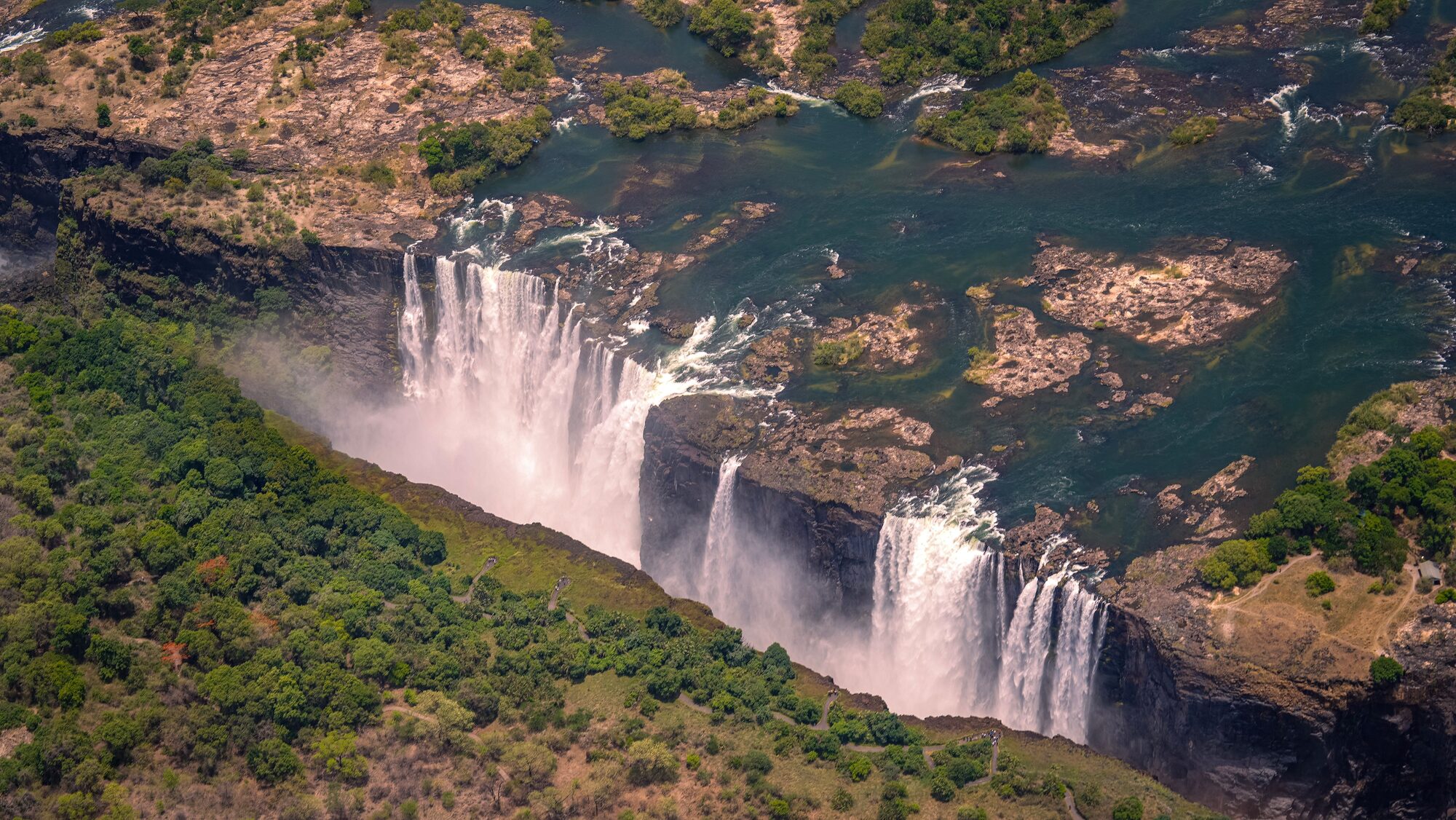
Victoria Falls is the largest sheet of falling water on earth, formed where the Zambezi River drops as much as 108 metres into the Batoka Gorge along a lip 1.7 kilometres wide. Local Kololo and Lozi communities named it Mosi-oa-Tunya, "the smoke that thunders", long before the Scottish missionary David Livingstone became the first European to see it in 1855 and named it after his queen. It was designated a UNESCO World Heritage Site in 1989, straddling the border between Zimbabwe and Zambia.
Roughly three-quarters of the falls' width sits on the Zimbabwean side, and Zimbabwe has traditionally been the more popular base for first-time visitors because of it. The rainforest path here strings together 16 designated viewpoints along a mile of gorge-side trail, giving the widest, most complete panorama available from either country. Victoria Falls town, a short walk from the park gate, has grown into the region's adventure-tourism hub, offering everything from bungee jumping to gentle sunset cruises. This guide covers what every visitor needs to know before booking.
Key takeaways: visiting Victoria Falls, Zimbabwe
- Zimbabwe has the best views: around three-quarters of the falls' width sits on this side, giving the widest, most complete panorama of any single vantage point.
- 2026 entry fee: $58 per person per day for international visitors at the main gate, following a tariff increase tied to VAT on tourism services.
- Best time to visit: June to August for the best balance of strong water flow, clear skies and peak safari season; February to May for the most dramatic (but mistiest) views.
- Visa: most non-African visitors need one; buy the KAZA Univisa ($50) instead of a standard Zimbabwe visa if you plan to cross into Zambia or Botswana too.
- Devil's Pool is on the Zambian side, not Zimbabwe, but the KAZA Univisa makes a half-day crossing straightforward.
Best time to visit
Victoria Falls is a year-round destination, but the character of the experience changes dramatically depending on the Zambezi's water levels, which rise and fall with rainfall far upstream in Angola and Zambia. There is no single "best" month; the right time depends on what you have come to see.
High water runs from roughly February to May, with peak flow typically in March and April. This is when the falls are at their most powerful, sending up a column of spray visible from kilometres away and drenching the rainforest path in constant mist. The spectacle is immense, but visibility at ground level can be poor; some viewpoints disappear into cloud entirely, and a raincoat is not optional. White-water rafting and Devil's Pool close during this period, as the river becomes too dangerous.
Low water runs from roughly August to December, tapering to its lowest point in October and November before the first rains arrive. Spray drops away, revealing the sheer basalt cliff face and the full width of the falls in clear, photogenic detail. This is when white-water rafting operates at its wildest, when Devil's Pool opens on the Zambian side, and when nearby game reserves such as Hwange and Chobe offer their best wildlife viewing, as animals concentrate around the remaining waterholes.
Because Zimbabwe holds around three-quarters of the falls' width, it retains a strong flow of water throughout the year, unlike the Zambian side, where the eastern cataract can run almost dry between October and December. Visitors with only one side to choose, or only a short window to visit, are on safer ground picking Zimbabwe regardless of season.
Park entry fees
Access to Victoria Falls Rainforest, on the Zimbabwean side, is managed by the Zimbabwe Parks and Wildlife Management Authority, known as ZimParks. Entry is charged per person per day and is separate from any activity, tour or accommodation cost.
Moonlight viewing, held on the nights around each full moon, is one of the more unusual experiences on offer here: with sufficient spray, the moon can cast a faint "lunar rainbow" across the falls. It runs on a fixed lunar schedule rather than daily, so check dates with ZimParks or your lodge before planning around it.
Payment methods at the gate include US dollar cash, which is always accepted and worth carrying regardless of what else you bring, and card payment, which has been available since 2022 but is prone to outages. Guided day tours booked through a tour operator typically include park entry in the price; independent visitors pay directly at the gate.
Visa and entry requirements
Zimbabwe operates a three-category visa system based on nationality. Citizens of most SADC countries, including South Africa, enter visa-free for up to 90 days. Most Western nationalities, including UK, US, EU, Canadian and Australian passport holders, fall into the category eligible for a visa on arrival or an eVisa applied for in advance. A smaller group of nationalities must apply at a Zimbabwean embassy before travelling.
For eligible nationalities, a single-entry Zimbabwe visa costs $30, a double-entry visa $45, and a multiple-entry visa $55 (the latter requires a supporting letter), all valid for 30 days. The eVisa can be applied for online in advance at Zimbabwe's official portal, which speeds up arrival, or purchased on arrival at Victoria Falls Airport or Harare International Airport.
A passport valid for at least six months beyond your arrival date, with at least two blank pages, is required. A yellow fever vaccination certificate is mandatory if arriving from, or transiting through, a country with risk of yellow fever transmission. Requirements change periodically; the Zimbabwe Department of Immigration's official channels should be checked for your specific nationality before travel.
Adventure activities
Victoria Falls town has built one of Africa's densest concentrations of adventure activities around the falls and the gorge below the bridge. Most operators run out of the town centre, and transfers to activity sites are typically included in the price.
The Victoria Falls Bridge
Built in 1905 to carry Cecil Rhodes's Cape-to-Cairo railway, the bridge spans the Second Gorge directly beneath the falls and now doubles as one of the world's most scenic adrenaline venues. The bungee jump plunges 111 metres towards the Zambezi below; the platform sits in the no-man's-land between the Zimbabwean and Zambian borders, so a passport is required even for the jump. The same site offers a gorge swing, a bridge slide, and a historical bridge tour that walks visitors underneath the structure itself. The minimum age for the bungee is 15.
White-water rafting
The rapids below the falls are rated among the best commercially run Grade 4 and 5 white water anywhere in the world, threading through the narrow Batoka Gorge with names such as Oblivion and Commercial Suicide. Rafting runs from roughly August to December, when lower water exposes the fiercest rapids; the river closes to rafting during peak flood, typically February to May, when conditions become too dangerous to run commercially.
Flight of Angels
A helicopter flight, known locally as the Flight of Angels, gives the clearest sense of the falls' scale, tracing the zigzag gorges downstream after circling the main cataract. It runs year-round and is particularly worthwhile during high water, when ground-level views are obscured by spray but the aerial view is unaffected.
Devil's Pool, across the border
Devil's Pool, the natural rock pool perched on the very lip of the falls, is not on the Zimbabwean side. It is reached via Livingstone Island, accessible only from Zambia, and is open roughly from mid-August to mid-January depending on water levels. Visitors staying in Victoria Falls town who want to swim at the edge cross the border for a half-day trip; the KAZA Univisa makes this a straightforward add-on rather than a separate visa application.
Beyond the falls
The Zambezi River sunset cruise is the low-key counterpoint to the adrenaline activities, drifting upstream from the falls as hippos and elephants come down to the water. Zambezi National Park, immediately upstream of the falls on the Zimbabwean side, offers game drives with a reasonable chance of lion, elephant and buffalo. Chobe National Park in Botswana, reachable as a day trip via the Kazungula border, is one of the continent's most reliable places to see large elephant herds, and pairs naturally with a Victoria Falls stay for visitors travelling on the KAZA Univisa.
Accommodation options
Budget
Victoria Falls town has a well-established backpacker scene, with hostels and budget guesthouses clustered close to the town centre and within walking distance of the park gate. These typically offer dormitory beds alongside private rooms, communal kitchens or bar-restaurants, and easy access to activity bookings. This end of the market suits travellers who have put their budget into activities rather than accommodation, and who are comfortable with simple, shared facilities.
Midrange
Ilala Lodge Hotel is the standout midrange choice, geographically the closest hotel to the falls and an eight-minute walk from the park entrance, with 56 rooms set in gardens where warthog and impala regularly graze. Batonka Guest Lodge, a boutique colonial-style property on the edge of town, and the Palm River Hotel, set on the Zambezi upstream of the falls, are similarly well regarded. Rooms here typically run from around $150 to $350 per person per night, usually on a bed-and-breakfast or half-board basis.
Luxury
The Victoria Falls Hotel, opened in 1904 as accommodation for railway workers and now Zimbabwe's grandest hotel, overlooks the Victoria Falls Bridge and Batoka Gorge and remains the classic choice for a first visit. Anantara Stanley & Livingstone, set in its own game reserve 15 minutes from the falls, combines Big Five game drives with proximity to town. Matetsi River Lodge and Matetsi Victoria Falls, further upstream along a private stretch of the Zambezi, and Victoria Falls River Lodge, inside Zambezi National Park itself, offer a quieter, more safari-oriented base within reach of the falls. Luxury properties typically charge from around $400 to $800 per person per night, all-inclusive.
Costs and budgeting
There is no permit system at Victoria Falls comparable to gorilla trekking in East Africa; the main fixed cost is the daily park entry fee, currently $58 per person for international visitors. Beyond that, costs are driven almost entirely by choice of accommodation and how many activities you add on.
A realistic daily activity budget for two adrenaline activities, such as a helicopter flight and white-water rafting, runs to roughly $250 to $400 per person, since individual activities are typically priced between $130 and $200 each. A three-night trip for two people combining midrange accommodation, park entry, one or two activities and meals falls in the region of $2,500 to $4,000. Budget travellers staying in backpacker accommodation and limiting activities to the falls, a sunset cruise and a bridge walk can manage a similar trip for under $1,500 for two. Luxury itineraries combining Victoria Falls with a Hwange or Chobe safari extension routinely exceed $10,000 per person.
What to pack
The single most important item is a proper waterproof layer, not an umbrella. During high water, spray from the falls falls upwards as much as down, and the rainforest path can leave visitors soaked within minutes; rain ponchos are sold at the entrance, but a real waterproof jacket holds up better. Quick-drying clothing and sturdy, closed-toe shoes with grip are worth packing regardless of season, as paths can be slippery with spray even outside the wettest months.
Zimbabwe's winter mornings, from roughly May to August, are colder than most visitors expect; nights can drop to single figures Celsius, so a warm layer for early activity departures and evening cruises is essential even though daytime temperatures are comfortable. Swimwear is useful year-round, for hotel pools and for the Zambezi's calmer stretches. Sunscreen and insect repellent are necessary throughout the year, and Victoria Falls falls within a malaria risk zone, so consult a travel health clinic before departure. A passport should be carried on any visit to the Victoria Falls Bridge, including for the bungee jump, as the platform sits in no-man's-land between the two countries' border posts.
Getting there
Victoria Falls International Airport (VFA), 18 kilometres south-east of town, is the main gateway. It was rebuilt with a new international terminal in 2016 and now handles direct flights from Johannesburg (around 1 hour 40 minutes) on Airlink, South African Airways and FlySafair, from Cape Town on Airlink, and from Harare (around 1 hour 10 minutes, 556 kilometres) on fastjet and Air Zimbabwe. Ethiopian Airlines and Kenya Airways connect Victoria Falls to their respective hubs for onward international travel. Most hotels include airport transfers or can arrange them; taxis are also readily available at the terminal.
Self-driving is possible with a saloon car on tarred roads to town, though a 4WD is preferable for excursions further afield. The distance from Johannesburg is approximately 1,200 kilometres via Botswana, or around 1,300 kilometres via the Beitbridge border and Bulawayo. Both routes take a full day or more, and many self-drivers break the journey overnight rather than attempt it in one push.
A slower and more scenic alternative is the railway. A regular passenger service connects Bulawayo to Victoria Falls, running overnight through Hwange National Park, where wildlife is sometimes visible from the carriage. Rovos Rail, the luxury operator, runs a multi-day service between Pretoria and Victoria Falls for travellers who want the journey itself to be part of the holiday.
Frequently asked questions
How much does it cost to enter Victoria Falls National Park in Zimbabwe in 2026?
International visitors pay $58 to enter through the main gate, $174 through the VIP gate, and $116 for moonlight viewing, following a 2026 tariff increase tied to the introduction of VAT on tourism services. SADC visitors pay $35, $87 and $81 respectively. Zimbabwean citizens pay $7, $30 and $15 respectively.
What is the best time to visit Victoria Falls?
High water, from February to May and peaking around March and April, gives the most powerful display but can obscure views in spray. Low water, from August to December, clears the mist and opens up white-water rafting and Devil's Pool. June to August offers a good middle ground of strong flow, clear skies and prime safari conditions nearby.
How many days do you need at Victoria Falls?
Two nights covers the falls and one activity. Three nights allows a bigger activity, such as rafting, or a day trip to the Zambian side. Visitors combining the falls with a safari in Hwange or Chobe should plan for at least five nights in total.
Do I need a visa to visit Zimbabwe?
Most non-African nationalities do. A single-entry visa costs $30, a double-entry visa $45, and a multiple-entry visa $55, all valid for 30 days. Visitors planning to cross into Zambia should instead buy the KAZA Univisa for $50, covering both countries plus Botswana day trips. SADC citizens generally enter visa-free for up to 90 days.
Is Devil's Pool on the Zimbabwe side of Victoria Falls?
No. It is on Livingstone Island, reached only from Zambia, and open roughly mid-August to mid-January depending on water levels. Visitors based in Zimbabwe need to cross the border to reach it, which the KAZA Univisa makes straightforward.
How do you get to Victoria Falls, Zimbabwe?
Victoria Falls International Airport, 18 kilometres from town, has direct flights from Johannesburg, Cape Town and Harare. Self-driving from Johannesburg takes around 1,200 to 1,300 kilometres depending on route. A slower alternative is the rail line from Bulawayo, or the luxury Rovos Rail service.
Comments
Loading comments…