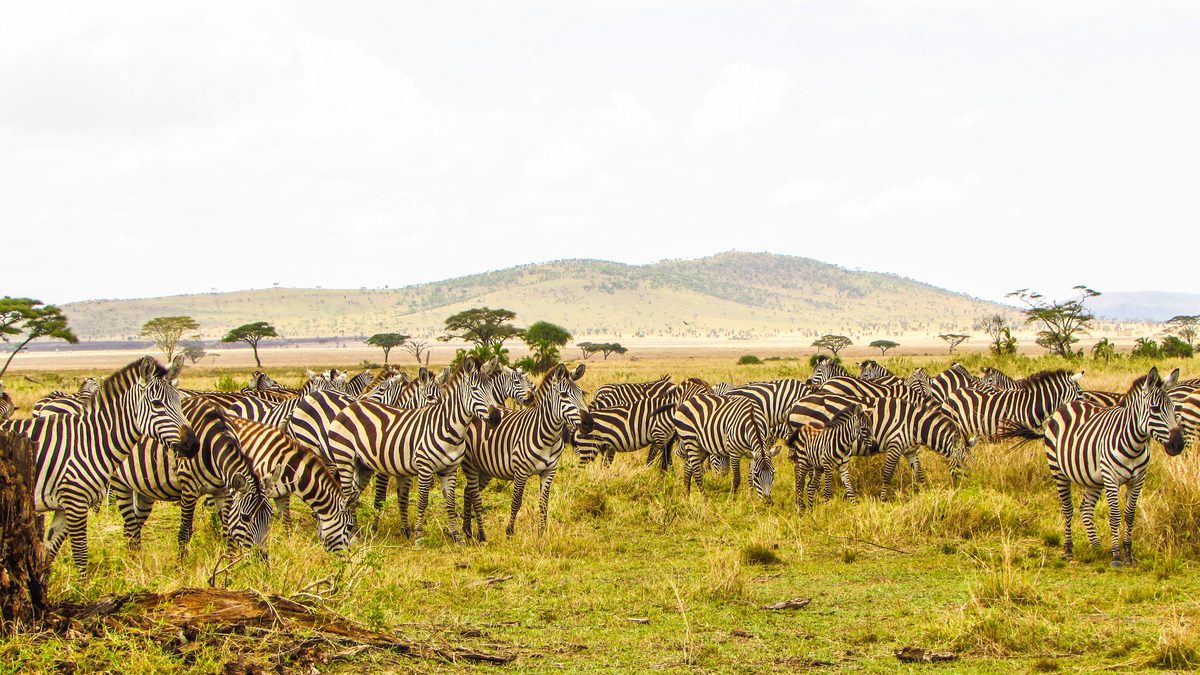
The Serengeti National Park covers 14,763 square kilometres of savanna grassland and acacia woodland in northern Tanzania, forming the southern anchor of the same ecosystem that extends north into Kenya's Maasai Mara. Established in 1951 and designated a UNESCO World Heritage Site in 1981, it is the largest national park in Tanzania's Northern Circuit and holds one of the densest concentrations of large mammals anywhere on earth. Approximately 3,000 to 4,000 lions, 1,000 leopards, 550 cheetahs and over two million ungulates inhabit the park, alongside more than 500 bird species.
The Serengeti is best known for the Great Migration, the annual movement of roughly 1.7 million wildebeest, 500,000 zebra and 200,000 Thomson's gazelle around the ecosystem in search of fresh grazing. Unlike a single event, the migration is a continuous cycle that plays out differently in each zone of the park throughout the year, which means timing and positioning are critical decisions for any visitor. This guide covers the full migration calendar, what to expect from the resident wildlife, current park fees, accommodation options across budget tiers, Tanzania's entry requirements and how to get to the Serengeti.
Best time to visit
The Serengeti can be visited year-round and produces good game viewing in every month, but the experience varies considerably by season and zone. The migration cycle follows a broadly predictable north-south circuit driven by rainfall and grass growth, and understanding it is the most useful frame for deciding when to go.
From December through March, the herds are concentrated on the short-grass plains of the southern Serengeti, around Ndutu and the Ngorongoro Conservation Area border. January and February are the calving season, when roughly 8,000 wildebeest calves are born each day over a three-week period. The calving draws large numbers of predators and produces intense action on the plains. This is also one of the most affordable periods to visit, with rates at most camps below the July to October peak.
From April to June, the herds begin moving north and west. April and May coincide with the long rains: the landscape is green and atmospheric, rates drop significantly, and visitor numbers are low. The Western Corridor becomes productive in June and July, when the herds cross the Grumeti River, which holds resident crocodile populations and produces dramatic crossing events before the larger Mara River crossings further north.
July to October is the peak season. The herds reach the northern Serengeti and the border zone near the Maasai Mara, and the Mara River crossings, where large groups of wildebeest charge through crocodile-filled water, are at their most frequent. August sees the highest visitor numbers and the most reliable crossing activity, while September offers similar drama with noticeably fewer vehicles at sighting points. October and November mark the return south as the short rains begin, with the herds passing through the eastern Serengeti before cycling back to the south.
In summary: July to October offers the most dramatic migration action and the highest predator density, at peak prices. January to March offers the calving season, good game viewing and lower costs. June and September are well-regarded shoulder months that balance activity with manageable visitor numbers. April and May are the quietest and cheapest, suited to visitors who prioritise solitude and green scenery over migration spectacle.
What wildlife to expect
The Serengeti holds one of the most reliable Big Five experiences in Africa. Lion prides are numerous and well habituated to vehicles, particularly around the Seronera Valley in the central Serengeti, which supports one of the most studied lion populations on the continent. The resident prides here can be large, and sightings of hunts and kills are possible at any time of year. Leopard are present throughout the park but are most reliably seen along the riverine forest bordering the Seronera River, where they use the fig and acacia trees as resting and feeding platforms.
Cheetah density in the Serengeti is among the highest anywhere in Africa, with an estimated 550 individuals in and around the park. The open short-grass plains of the south are the best areas for cheetah sightings, particularly during the calving season when prey is abundant. Black rhino numbers are critically low, with fewer than 70 individuals remaining in the park following decades of poaching pressure; sightings are possible but should not be treated as an expectation.
African elephant herds recovered significantly from a poaching low in the 1980s and numbered over 5,000 individuals within the park by the mid-2010s. Buffalo are present in large herds across much of the park. Giraffe, zebra, hippo, Thomson's gazelle, Grant's gazelle, topi, eland and impala are all common, alongside spotted hyena, African wild cat, bat-eared fox and the occasional serval. The rivers hold substantial populations of Nile crocodile, most visible during migration crossings but resident year-round.
For birdwatchers, the Serengeti records over 500 species, including five endemics, with around 60 raptor species. The park is excellent for large ground birds including ostrich, secretary bird and kori bustard, and the open grasslands support abundant lilac-breasted rollers, superb starlings and several species of vulture.
The migration calendar in brief
Keeping the migration calendar in mind when choosing a zone and camp makes a significant difference to what is likely to be seen on a given trip. The four zones of the Serengeti each have a productive window tied to where the herds are likely to be.
The southern Serengeti, centred on the Ndutu Plains, is the calving zone from roughly December to March. The western Serengeti and Grumeti River area is most productive from April to July, when the herds move through the Western Corridor. The northern Serengeti, including the Kogatende and Lamai areas bordering the Maasai Mara, is the prime zone for Mara River crossings from July to October. The eastern Serengeti around Lobo sees the herds pass through on the return south in October and November.
A camp positioned in the north during August or September, or in the Ndutu area during February, will be far better placed for migration sightings than a central Seronera camp during the same periods. The central Serengeti is the most reliable zone for resident predators year-round but is not the most productive area for migration-specific activity.
How long to stay
Three nights is a workable minimum for a first Serengeti visit, giving two full days of game drives. However, the park is large enough, and the zones sufficiently distinct, that four to six nights is more practical for visitors who want to cover more than one area or increase their chances of seeing a river crossing during the July to October window. Fly-in itineraries make it possible to base in two different zones on a single trip, spending time in the central Serengeti before repositioning to the north, which is the most effective approach for a combined predator and migration experience.
Entry requirements and visa
Most foreign nationals visiting Tanzania need an eVisa, applied for online before travel via the official government portal at eservices.immigration.go.tz. The standard single-entry tourist eVisa costs $50 for most nationalities and is valid for stays of up to 90 days. US passport holders are treated differently and are required to apply for a multiple-entry visa at $100, valid for 12 months. Processing typically takes between three and ten working days, and it is worth applying at least two weeks before travel to allow for delays. Tanzania does still offer visa on arrival at major international airports and some land borders, but the eVisa is strongly recommended to avoid queues and uncertainty on arrival.
A yellow fever certificate is required for travellers arriving from, or transiting through, countries where yellow fever is endemic. It is not required for visitors flying directly from the United Kingdom, mainland Europe or North America. Tanzania also requires a passport valid for at least six months from the date of entry, with at least one blank page for stamps.
One point worth noting for travellers combining Tanzania with Kenya: the East African Tourist Visa (EATV), which covers Kenya, Uganda and Rwanda on a single document, does not include Tanzania. A separate Tanzania eVisa is required for any itinerary that includes the Serengeti, even if an EATV is already held for neighbouring countries.
Park fees and costs
Park fees for the Serengeti are set by the Tanzania National Parks Authority (TANAPA) and charged per adult per 24 hours. As of 2026, the fee for non-resident foreign tourists is $83 per adult per 24-hour period, regardless of whether it is peak or low season. Children aged 5 to 15 pay $24 per 24 hours; children under 5 enter free. All fees are subject to 18% VAT, which is applied on top of the base rate. TANAPA announced a fee freeze in May 2025 with rates confirmed unchanged until at least March 2026, with any future increases requiring a minimum of 12 months' notice.
In addition to the park entry fee, guests staying inside the park at any camp, lodge or tented facility pay a concession fee on top of their accommodation rate. For non-resident foreign tourists, this is $60 per adult per 24 hours during peak season (July to September) and the same $60 per adult per 24 hours during low season. Children aged 5 to 15 pay $12 per 24 hours. VAT applies to the concession fee as well. In practical terms, a foreign tourist staying inside the park pays a combined $83 + $60 + 18% VAT = approximately $168 per adult per 24 hours in park fees and concession charges alone, before accommodation costs are added. These fees are typically bundled into all-inclusive camp packages, but it is worth confirming with your operator exactly what is and is not included in the quoted rate.
Accommodation costs vary considerably by tier. Budget options, mostly public campsites and more basic tented lodges in or near the park, start from around $150 to $200 per person per night. Midrange tented camps, with private bathrooms, full board and guided game drives, run from approximately $300 to $600 per person per night and represent the most popular tier for first-time visitors. Luxury camps, particularly in the northern Serengeti and on private concessions, start at around $700 per person per night and can exceed $2,000 during peak migration season. These figures are per person and typically include all meals, game drives and, in some cases, additional activities such as walking safaris or hot air balloon flights.
Getting to the Serengeti from Arusha by scheduled light aircraft takes approximately one hour, compared to a five to six hour road transfer. One-way fares to Seronera Airstrip, the main hub in the central Serengeti, are published at around $265 per person from Arusha. Flights to the northern airstrips at Kogatende and Lobo are priced higher, at $400 to $550 one way, reflecting the greater distance. Baggage on light aircraft is restricted to 15 kilograms per passenger, which is worth noting when packing.
Accommodation options
Budget
Budget options include public campsites such as Seronera, Pimbi and Nyani in the central Serengeti, where camping fees for non-residents start at around $30 per person per night, plus park fees. More comfortable budget-tier tented lodges such as Seronera Wildlife Lodge and Kati Kati Tented Camp offer private rooms and basic facilities at around $150 to $200 per person per night all-inclusive. These options are best suited to visitors who prioritise cost over camp exclusivity and are comfortable sharing sighting areas with more vehicles.
Midrange
Midrange camps at $300 to $600 per person per night provide a significantly improved experience: permanent tented accommodation with proper beds and en suite bathrooms, full board, qualified guides and well-positioned access to game areas. Camps in the Seronera Valley, such as Kubu Kubu Tented Lodge, sit close to some of the best leopard territory in the central Serengeti. At this tier, group sizes are smaller and the level of guiding is generally stronger than in the budget category.
Luxury
Luxury camps in the northern Serengeti, particularly around Kogatende and the Lamai Wedge, are positioned for the best access to Mara River crossings during peak migration. Properties in this tier are small, often with 10 to 20 beds, operate on exclusive or semi-exclusive concessions, and offer private game drives, walking safaris and night drives. Hot air balloon safaris, which depart at dawn and last approximately an hour over the plains, are a common addition at this tier, at an additional cost of around $600 to $700 per person. These camps book out months in advance for July and August.
What to pack
The Serengeti sits at elevations ranging from approximately 920 to 1,850 metres. Mornings and evenings are cool, particularly in the dry season between June and October, when temperatures at dawn can drop to around 10 to 15°C. Midday temperatures rise to the mid to high twenties. Packing light layers that can be added and removed during a game drive is more practical than heavy clothing.
Neutral colours, such as khaki, olive, tan and grey, are recommended for game drives. Bright whites and primary colours should be avoided, as they can disturb wildlife and are conspicuous in the landscape. A good pair of binoculars, at 8x42 or 10x42 specification, will significantly improve sightings of distant wildlife and birds. For photography, a lens in the 100 to 400mm range covers most situations; a beanbag or window-mount support is more stable inside a moving vehicle than a tripod. Sunscreen, a wide-brimmed hat and a light waterproof layer are worth carrying in all seasons. Luggage on light aircraft is restricted to 15 kilograms in a soft bag, so packing discipline matters more on a fly-in safari than it does on a road-based trip.
Getting there
The main international entry points for a Serengeti safari are Kilimanjaro International Airport (KIA), near Arusha, and Julius Nyerere International Airport in Dar es Salaam. Kilimanjaro is the more convenient option for the northern circuit, as it places travellers within Arusha for onward connections. Arusha Airport, a smaller domestic airfield about 15 minutes from the town centre, is the hub for scheduled light aircraft services to Serengeti airstrips including Seronera, Kogatende, Lobo, Grumeti and Ndutu. Road transfers from Arusha to the park take five to six hours on reasonable road as far as Naabi Hill Gate, with rough tracks inside the park thereafter.
The Serengeti is most commonly visited as part of a Northern Circuit itinerary that also includes Ngorongoro Crater, Tarangire or Lake Manyara, all of which are accessible from Arusha. Most reputable operators include airport transfers, road or air transfers to the park and all game drives in their quoted packages.
Frequently asked questions
Is the Serengeti worth visiting?
Yes. The Serengeti holds one of the largest concentrations of wildlife in Africa, with approximately 3,000 to 4,000 lions, 1,000 leopards, 550 cheetahs and over two million ungulates. The Great Migration, the largest land animal movement on earth, is present in the ecosystem for most of the year.
How many days do you need in the Serengeti?
Three nights is a workable minimum for a first visit. Four to six nights is more practical for visitors trying to follow the migration or cover more than one zone of the park.
What is the best month to visit the Serengeti?
July to October is peak season, when the migration herds are in the north and the Mara River crossings occur. January and February are excellent for the wildebeest calving season in the south. June and September offer good game viewing at slightly lower cost and with fewer visitors than the August peak.
Do I need a visa to visit the Serengeti?
Most foreign visitors to Tanzania need an eVisa, applied for online before travel via the official portal at eservices.immigration.go.tz. The standard single-entry tourist eVisa costs $50 for most nationalities. US citizens are required to apply for a multiple-entry visa at $100. Visa on arrival is available at major entry points but the eVisa is the recommended option.
How much does a Serengeti safari cost?
Costs vary widely by accommodation tier. Budget camping safaris and basic lodges start at around $150 to $200 per person per night. Midrange tented camps run from $300 to $600. Luxury camps start at around $700 and can exceed $2,000 per person per night during peak migration season. Park fees of $83 per adult per 24 hours, plus a concession fee of $60 per adult per 24 hours for guests staying inside the park, apply on top of accommodation and are subject to 18% VAT.
Is the Serengeti safe to visit?
The Serengeti is a well-established safari destination managed by the Tanzania National Parks Authority. Game drives are conducted by licensed guides in 4WD safari vehicles, and camps brief guests on wildlife safety. The park is considered safe for visitors who follow guide instructions and exercise standard travel precautions in Tanzania.