The Okavango Delta is the world's largest inland delta, formed where the Okavango River spills into the sands of the Kalahari Basin in northern Botswana instead of reaching the sea. Its size shifts with the seasons, from around 15,000 square kilometres in the dry months to as much as 22,000 square kilometres at the height of the annual flood. The delta was inscribed as a UNESCO World Heritage Site in 2014, recognised as the 1,000th site added to the list, for the rare combination of climatic, hydrological and biological processes that sustain it.
What makes the Okavango distinct from most other safari destinations is that there is no public road network into its interior. Access is almost entirely by light aircraft from Maun, and game viewing combines conventional 4WD drives with mokoro canoe trips and motorboat safaris through flooded channels, something not possible in a dry savanna park. The delta supports around 122 mammal species and more than 440 bird species, and is one of the most reliable places in Africa to see African wild dog. This guide covers the flood calendar, what wildlife to expect, current park fees, accommodation across budget tiers, Botswana's entry requirements and how to get to the delta.
Best time to visit
The Okavango Delta floods during Botswana's dry season, not its wet season, which is the defining quirk of the system. Rain falling over the Angolan highlands between November and April takes around four months to travel more than 1,000 kilometres south through Namibia's Caprivi Strip before reaching the delta, so the floodwaters arrive just as local rainfall stops. Water levels begin rising in May, build through June, and typically peak in July and August.
June to August is peak season. Skies are clear and dry, vegetation is low, and rising water concentrates wildlife around the remaining channels and floodplains, making for some of the most reliable game viewing of the year. Mornings are cold at this time, with overnight temperatures in some areas dropping close to freezing, while afternoons remain comfortably warm. This is also when most camps offer mokoro and motorboat activities at their fullest extent, since the permanent channels are well supplied with water.
September and October mark the hottest, driest stretch of the year. Floodwaters begin to recede, and as the surrounding land dries out completely, animals cluster tightly around whatever water remains, often producing exceptional sightings even as visitor numbers thin slightly compared to the July and August peak. Daytime temperatures regularly climb into the mid-thirties by October.
November to April is the green season. Local thunderstorms green the landscape quickly, migratory birds arrive in large numbers, and antelope calving draws predator activity, though sightings are generally more dispersed than in the dry months. Water levels are at their lowest during this period, since the delta has not yet received the new season's flood from Angola, so some camps reduce or suspend mokoro and boating activities and rely more on game drives and walking.
What wildlife to expect
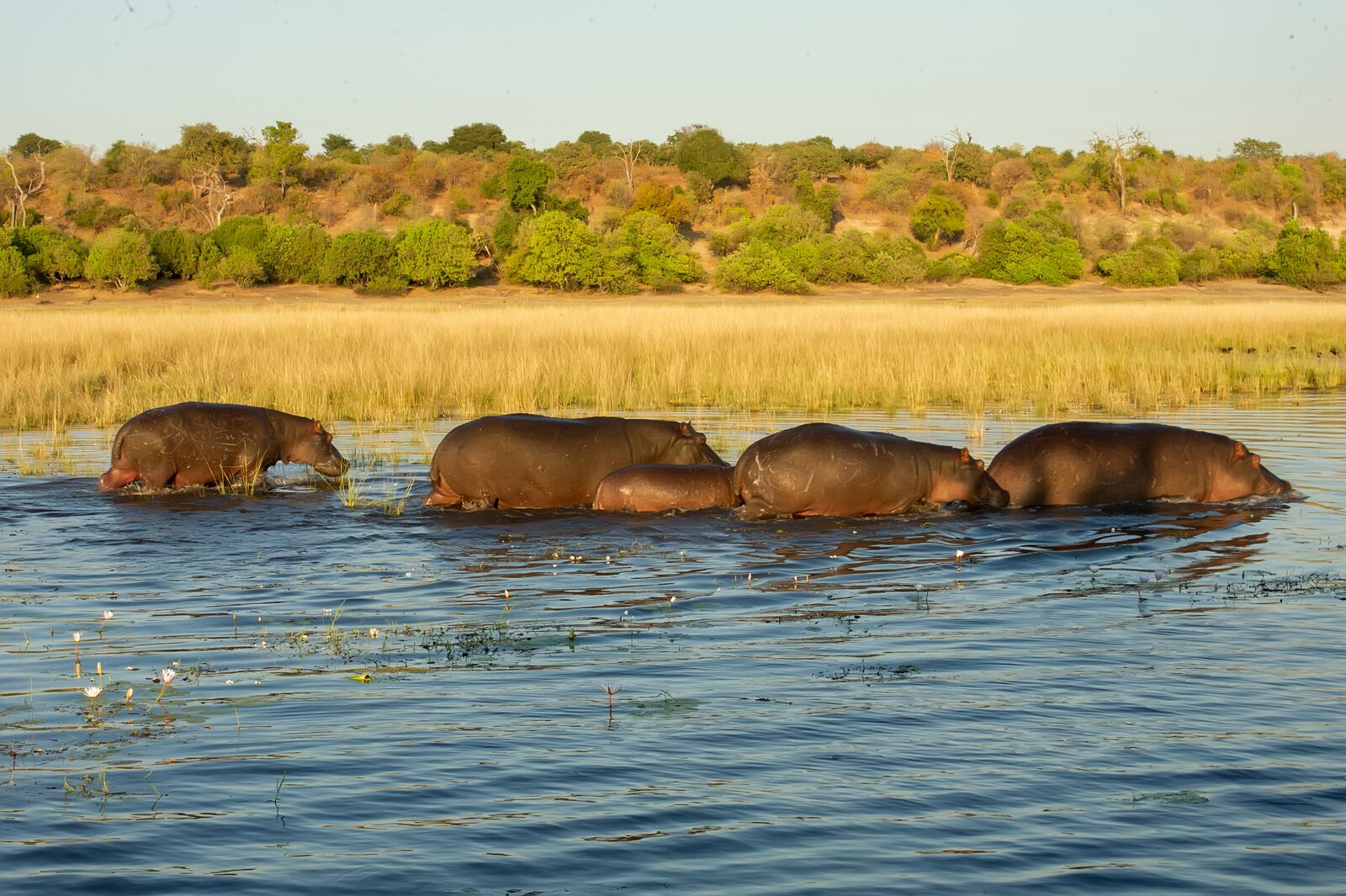
The Okavango supports one of the largest elephant populations of any ecosystem in Africa. Northern Botswana, spanning the Okavango and Chobe regions, holds the largest national elephant population on the continent, with estimates exceeding 130,000 animals. Buffalo move through the delta in large herds, particularly on the floodplains bordering Chief's Island, and hippo and Nile crocodile are present in good numbers throughout the permanent channels.
Predator viewing is strong, though it differs in character from East Africa's open plains. Lion and leopard are both present and well habituated to vehicles in the private concessions surrounding Moremi Game Reserve, while cheetah favour the drier grassland fringes. The Okavango is best known among predator specialists for African wild dog: Botswana holds one of the largest free-ranging wild dog populations remaining in Africa, and the delta and surrounding concessions are consistently ranked among the best places on the continent to see them.
Rhino numbers in the delta remain low following a poaching crisis in the surrounding region, but both white and black rhino have been reintroduced under a dedicated conservation programme, with white rhino numbers in the low tens and black rhino in single figures. Sightings should not be treated as an expectation. The delta's signature antelope is the red lechwe, a semi-aquatic species adapted to wading through flooded grassland, present in numbers running into the tens of thousands and most easily seen on the floodplains around Moremi and the private concessions. Sitatunga, a shyer swamp-adapted antelope, are present in much smaller numbers and require patience and a good guide to locate.
Other commonly seen species include giraffe, plains zebra, blue wildebeest, greater kudu, impala, tsessebe, sable and roan antelope, warthog and chacma baboon. Birdlife is exceptional throughout the year, with the delta recording over 440 species, including African fish eagle, Pel's fishing owl and wattled crane, and a strong influx of migratory species during the November to April green season.
Moremi, concessions and the panhandle
The delta is managed across three broad zones that shape what a visit looks like. Moremi Game Reserve, proclaimed in 1963 by the local Batawana administration and recognised as one of the first protected areas in Africa established by an indigenous community rather than a colonial government, covers roughly a fifth of the delta and includes Chief's Island, Xakanaxa Lagoon and the Khwai River area. As a government-run reserve, Moremi restricts game drives to designated roads and does not permit night drives or off-road driving.
Surrounding Moremi is a patchwork of private concessions, leased from local land trusts and operated under exclusive or semi-exclusive traversing rights by individual camps. These concessions allow night drives, off-road driving and walking safaris, none of which are available inside Moremi itself, and tend to offer a more flexible and exclusive game-viewing experience as a result. Most of the delta's higher-end camps sit within these concessions.
To the north, the Okavango Panhandle is the permanent, river-like stretch of the delta before it fans out into the main system. It holds water year-round regardless of the flood cycle, and is the centre of the region's fishing and traditional mokoro culture, with the towns of Shakawe and Sepupa serving as access points. It is less visited by safari tourists than Moremi and the concessions but is a strong choice for birding and a quieter, water-focused trip.
How long to stay
Three nights at a single camp is a workable minimum, giving time to settle into both land and water-based activities. Because Moremi and the private concessions offer genuinely different experiences, government-run roads and daytime drives in one, night drives and walking in the other, five to seven nights split between two zones is a more complete way to see the delta. Fly-in transfers between camps take 15 to 45 minutes, which makes combining two or three areas on a single trip straightforward.
Entry requirements and visa
Most visitors to Botswana do not need a visa for tourism stays of up to 90 days within any 12-month period. This visa-exempt list includes Kenya and most other African nationalities, along with the United States, United Kingdom, European Union member states, Australia, New Zealand, Japan and South Africa. Travellers from countries not on the exempt list must apply for an eVisa online before travel, via the official portal at evisa.gov.bw, uploading a passport scan, travel itinerary and accommodation proof; processing typically takes around five working days, and the approval letter must be printed and carried, as airlines will deny boarding without it.
A passport valid for at least six months from the date of entry, with at least two blank pages, is required for all visitors regardless of visa status. A yellow fever certificate is required for travellers arriving from, or having transited through, a country where yellow fever is endemic; it is not required for visitors flying directly from the United Kingdom, mainland Europe, North America or East Africa.
Park fees and costs
Park and conservation fees in Botswana are charged per person per day and vary by nationality and which reserve is being visited. For Moremi Game Reserve and Chobe National Park, the two highest-tariff reserves, non-resident foreign visitors pay a conservation fee of 270 Botswana pula per day, which converts to approximately $20 at current exchange rates. Botswana citizens pay 10 pula per day and SADC residents pay 30 pula per day for the same reserves. In Botswana's other national parks and game reserves, such as Chobe's neighbouring areas and the Central Kalahari, non-resident fees are lower, at 190 pula per day, roughly $14.
These government fees apply specifically inside Moremi Game Reserve. The majority of Okavango camps sit on private concessions outside Moremi's boundary, where a comparable community land-use fee is set by the relevant land trust and is built directly into the camp's nightly rate rather than charged separately at a gate. It is worth asking an operator to confirm exactly what is included in a quoted rate, since practice varies by camp.
Accommodation costs in the Okavango run noticeably higher than in East Africa, largely because almost all access is by light aircraft rather than road. Mobile camping safaris, in which a small group moves between serviced tented camps with a dedicated guide and crew, start from around $300 per person per night, fully inclusive of meals and activities. Midrange permanent tented camps run from roughly $600 to $1,300 per person per night; Camp Moremi, on the Xakanaxa Lagoon inside Moremi Game Reserve, published 2026 rates ranging from around $690 per person sharing in the low season to about $1,290 in the May to October peak. Luxury camps on private concessions start at around $700 per person per night and can exceed $2,000 during the July and August peak, particularly for smaller camps offering exclusive-use traversing rights.
Accommodation options
Budget
Genuine budget options inside the delta itself are limited, since there is no self-drive access to the interior. The lowest-cost route is a guided mobile camping safari, typically run as a multi-night circuit through Moremi and one or two private concessions, with simple dome tents, shared ablutions and a fixed daily rate from around $300 per person, fully inclusive of transfers, meals and game activities. Self-drive travellers can reach the southern and eastern fringes of Moremi by 4WD from Maun and camp at public sites, paying camping fees on top of the standard park fee, but this route does not reach the delta's flooded interior.
Midrange
Midrange camps, generally $600 to $1,300 per person per night depending on season, offer permanent tented accommodation with en suite bathrooms, full board and guided activities. Camps positioned inside Moremi, such as those on the Xakanaxa Lagoon, combine strong game viewing with relatively easy logistics, though they remain bound by the reserve's restrictions on night drives and off-road driving.
Luxury
Luxury camps sit almost entirely within private concessions bordering Moremi, particularly around Chief's Island and the northern concessions toward the panhandle. These camps are typically small, often under 20 beds, hold exclusive or semi-exclusive traversing rights, and offer night drives, walking safaris and off-road tracking that government reserves do not allow. Rates at this tier start around $700 per person per night and climb past $2,000 during the peak flood season, usually inclusive of all meals, drinks, laundry and most activities, with scenic helicopter flights and private guiding available at additional cost.
What to pack
The Okavango sits at a relatively low elevation for a southern African safari destination, but winter mornings between June and August are genuinely cold, with overnight temperatures in drier areas occasionally dropping below freezing, while daytime highs reach a comfortable 25°C. Layers that can be added and removed through the day, including a warm jacket and gloves for early game drives and mokoro outings, matter more here than in equatorial East Africa.
Neutral colours such as khaki, olive and grey are standard for game drives, with bright whites and dark colours best avoided. A pair of 8x42 or 10x42 binoculars improves sightings significantly, particularly for birding along the panhandle. For mokoro and boating activities, quick-drying clothing and closed shoes that can get wet are useful, since channels are shallow and boarding from the bank is common. Light aircraft transfers between camps restrict luggage to around 20 kilograms per person in a soft duffel bag, including hand luggage and camera equipment, which makes packing discipline a genuine constraint rather than a suggestion on a multi-camp itinerary.
Getting there
Maun Airport (MUB) is the gateway to the Okavango Delta and the only realistic point of entry for most visitors. Ethiopian Airlines is currently the sole long-haul carrier flying directly into Maun, connecting via Addis Ababa to a wide network of cities across Europe, the Middle East, Asia and the Americas. Most other international travellers connect through Johannesburg, Cape Town or Gaborone, all of which have several daily flights to Maun on regional carriers.
From Maun, transfer into the delta is by light aircraft on a shared charter basis, since there is no scheduled timetable and flights are arranged the day before departure based on passenger bookings. Flight times to camp airstrips range from 15 to 45 minutes depending on location, with aircraft such as the Cessna 206, Cessna Grand Caravan and Britten-Norman Islander commonly used. A handful of camps closer to Maun or along the southern boundary of Moremi can be reached by road, but this remains the exception rather than the rule.
Frequently asked questions
Is the Okavango Delta worth visiting?
Yes. The Okavango Delta is the world's largest inland delta and a UNESCO World Heritage Site, holding around 122 mammal species and over 440 bird species. It is one of the best places in Africa to see African wild dog, and offers a mix of game drives, mokoro canoe trips and boating not available in dry savanna parks.
How many days do you need in the Okavango Delta?
Three nights at a single camp is a workable minimum. Five to seven nights split between a private concession and Moremi Game Reserve allows for both water-based activities and a full range of game drives, including night drives, which are not permitted inside Moremi itself.
What is the best month to visit the Okavango Delta?
June to August is peak season, when floodwaters from Angola reach their highest levels and game viewing is at its best. September and October offer drier, hotter conditions with wildlife concentrated around shrinking water sources. January to March is calving season with strong birdwatching, at lower rates.
Do I need a visa to visit the Okavango Delta?
Most visitors, including citizens of Kenya, the United States, the United Kingdom, the European Union and South Africa, can enter Botswana visa-free for stays of up to 90 days within a 12-month period. Nationals of countries not on the visa-exempt list must apply for an eVisa online before travel via evisa.gov.bw.
How much does an Okavango Delta safari cost?
Costs are higher than in East Africa due to the fly-in access model. Mobile camping safaris start at around $300 per person per night. Midrange permanent tented camps run from roughly $600 to $1,300. Luxury camps on private concessions start at around $700 and can exceed $2,000 per person per night in peak season. Conservation and park fees are additional.
Is the Okavango Delta safe to visit?
The Okavango Delta is an established safari destination with no public road access into the interior, so almost all visitors arrive through licensed camps and operators. Game drives, mokoro trips and walks are conducted by trained guides, and the area is considered safe for visitors who follow guide instructions.