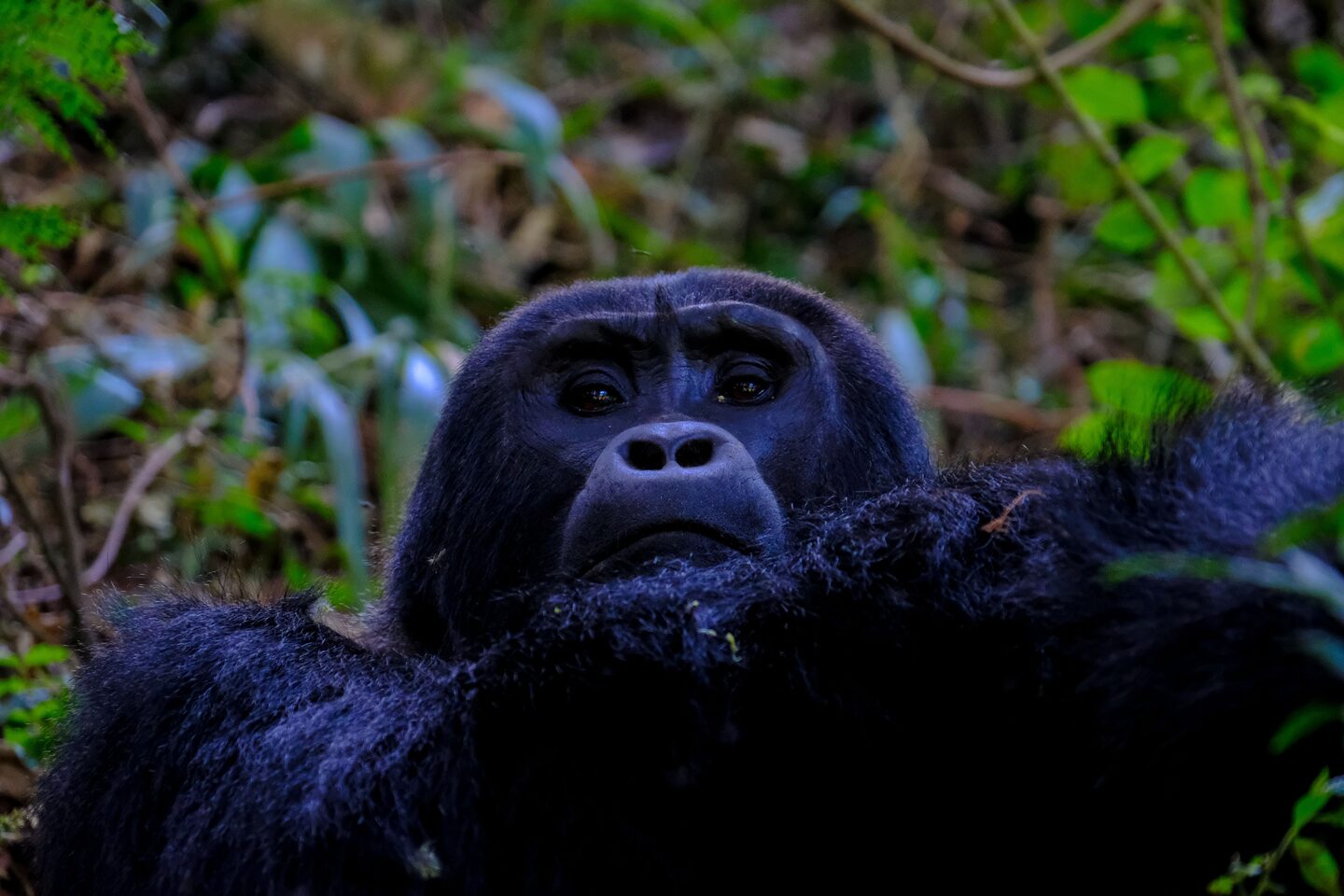
Bwindi Impenetrable National Park covers 331 square kilometres of ancient montane rainforest in south-western Uganda. It is one of the oldest forests on the continent, believed to have survived the last Ice Age as a refugium, and its age accounts for much of its extraordinary biological richness. The park holds more than 220 tree species, over 100 fern species, 348 bird species and at least 120 mammals. It was designated a UNESCO World Heritage Site in 1994.
For most visitors, Bwindi means one thing: mountain gorillas. Roughly half the world's remaining mountain gorilla population lives here, approximately 460 of an estimated 1,063 individuals. The park has more than 20 habituated gorilla families available for daily tourist visits, spread across four trekking sectors, and the count rises periodically as new families are habituated or existing ones split. This makes Bwindi the single largest source of gorilla trekking permits on earth, offering more access to mountain gorillas than Rwanda's Volcanoes National Park, Mgahinga Gorilla National Park and the Virunga range in the Democratic Republic of Congo combined. The experience is not cheap, and reaching the park takes effort. This guide covers what every visitor needs to know before booking.
Key takeaways: Bwindi Impenetrable Forest gorilla trekking
- 2026 permit price: $800 per person for foreign non-residents, dropping to $600 during the April, May and November low season.
- Best time to visit: the dry seasons, June to September and December to February, for firmer trails and easier trekking.
- Choose your sector first by permit availability: Buhoma suits first-timers, Rushaga has the most families and the habituation experience, Ruhija is best for birding, Nkuringo is the most remote and demanding.
- Book through a licensed Ugandan tour operator: foreign non-residents cannot book gorilla permits directly with UWA.
- Trekking rules: a strict seven-metre distance, groups capped at eight, minimum age 15 and no flash photography.
Best time to visit
Gorilla trekking in Bwindi is possible throughout the year, but season affects both the quality of the experience and the difficulty of the trek. Bwindi receives rainfall year-round. It is a rainforest. Two distinct dry seasons, however, produce significantly better trekking conditions: from June to September, and from December to February.
The dry season from June to September is the most popular period. Trails are firmer, vegetation is somewhat less dense, and the risk of heavy rain during a multi-hour trek is lower. July and August see the highest permit demand and are the most competitive months for booking. Visitors planning travel in this window should secure permits six to ten months in advance, particularly for popular sectors such as Buhoma and Rushaga.
December to February is the second dry season and draws nearly as much demand, particularly around Christmas and New Year. Permits for late December and early January regularly sell out a year in advance. Early December and February are easier to book and offer comparable trekking conditions.
April, May and November are the wetter months. Trails become muddy and slippery, and heavy rain can make trekking more demanding. These months do have real advantages. Permit availability is better, lodge rates are often lower and the forest is at its most lush. Gorillas tend to forage at lower elevations during wet months, which can result in shorter treks. For visitors who are flexible on dates and comfortable with mud, the low season offers good value.
Temperature at Bwindi is dictated by altitude rather than season. The park sits between 1,160 and 2,607 metres, and conditions vary considerably across the four sectors. Early mornings at higher-altitude sectors such as Nkuringo can be genuinely cold, dropping to around 7 or 8 degrees Celsius before dawn. Daytime temperatures in the forest are typically 15 to 20 degrees. Visitors often underestimate how cool Bwindi is and pack for a tropical climate. Layers are essential regardless of month.
The gorilla permit system
All gorilla trekking in Bwindi requires an official permit issued by the Uganda Wildlife Authority. The permit grants one hour with a single habituated gorilla family, accompanied by UWA ranger guides. Groups are capped at eight people per family per day to minimise disturbance. Across all of Bwindi's habituated families, upwards of 160 standard trekking permits are available per day, with the exact figure moving as UWA opens or closes families to trekking. The supply constraint is intentional. It protects the gorillas and preserves the quality of the encounter.
Current permit prices, set by UWA for the tariff period through June 2026, are as follows: foreign non-residents pay $800 per person per trek; foreign residents of Uganda pay $700; citizens of African countries outside the East African Community pay $500, a category introduced in July 2024; and East African Community citizens pay UGX 300,000. Children under 15 are not permitted to trek.
The permit is issued for a specific sector within Bwindi, not a specific gorilla family. Your sector determines which gate you report to on the morning of your trek, and your lodge must be within reasonable distance of that gate. The four sectors are several hours apart by road. Arriving at the wrong gate on trek morning is not recoverable. Confirm your sector with your operator before booking any accommodation.
UWA shares 20% of its annual park revenue with communities living around its protected areas, and at Bwindi specifically adds a further $10 from every standard gorilla permit sold, paid directly into district-level community projects such as schools, clinics and water systems. This revenue-sharing model is one reason gorilla numbers in Bwindi have kept rising even as the surrounding human population grows.
Trekking rules and etiquette
UWA enforces a strict set of rules on every trek to protect the gorillas and keep the encounter sustainable. These are not guidelines; rangers will end a visit early if they are broken.
- Keep a distance of at least seven metres from the gorillas at all times, even if they approach you.
- Groups are capped at eight trekkers per habituated family per day, plus rangers and guides.
- The minimum age is 15. There is no upper age limit, provided you can manage the terrain.
- Maximum viewing time is one hour for a standard permit, timed from the moment the group locates the gorillas.
- No flash photography. Standard photography and filming are permitted; flash can startle the gorillas.
- Anyone showing symptoms of a cold, flu or other contagious illness will be turned away at the pre-trek briefing. Gorillas share around 98% of human DNA and are highly susceptible to human respiratory diseases.
- No eating, drinking or smoking within view of the gorillas, and speak quietly.
- Do not touch the gorillas, even if a young gorilla approaches out of curiosity; step back calmly and let rangers manage the interaction.
The Gorilla Habituation Experience
For visitors wanting more than one hour with the gorillas, Bwindi offers the Gorilla Habituation Experience, known as the GHE. This permits up to four hours with a semi-habituated gorilla family as researchers and rangers continue accustoming them to human presence. Only four visitors are admitted per group per day. The experience is available only in Bwindi's southern Rushaga sector.
The GHE permit costs $1,500 for foreign non-residents and $1,000 for foreign residents through the remainder of 2026. UWA has confirmed a tariff revision taking effect on 1 January 2027, after which the foreign non-resident rate rises to $1,800 and the foreign resident rate to $1,600. Visitors trekking before the end of 2026 pay the current, lower rate regardless of when they book. The GHE suits photographers, wildlife researchers and anyone who found the standard one-hour window too brief on a previous visit.
Uganda vs Rwanda vs DR Congo
Bwindi is not the only place to trek mountain gorillas. Rwanda's Volcanoes National Park and the Virunga range in the Democratic Republic of Congo also offer habituated families, and first-time visitors researching the trip often end up deciding between Uganda and Rwanda specifically.
On price, Uganda is the clear winner: a standard permit costs $800 against $1,500 in Rwanda, a gap that widens further for couples or families. Uganda also offers the Gorilla Habituation Experience, unavailable in Rwanda, giving four hours with a gorilla family for less than the cost of two standard Rwandan permits. Rwanda's advantage is convenience. Volcanoes National Park sits under two hours from Kigali International Airport by road, against a full day's drive or a domestic flight to reach Bwindi from Entebbe, and its treks are generally shorter and less steep than Nkuringo or Ruhija. Rwanda has also invested heavily in ultra-luxury lodges close to the park boundary, which suits travellers on a short, high-end break.
The Democratic Republic of Congo's Virunga National Park has the cheapest permits, at around $400, but the security situation in eastern DRC has been unstable for extended periods and the UK Foreign Office and equivalent agencies elsewhere have at various points advised against travel to the area. Most operators steer independent travellers away from Virunga for this reason; it is not covered further in this guide. For a straightforward first gorilla trek with the widest choice of sectors, lodges and budget levels, Bwindi remains the strongest all-round option.
The four trekking sectors
Bwindi is divided into four geographically distinct sectors, each with its own character, altitude range and accommodation options. The choice of sector should be determined first by permit availability on your preferred dates, and second by the kind of experience you are looking for.
Buhoma (north)
Buhoma is the original gorilla trekking hub, situated in the north-western corner of the park. It is the closest sector to Queen Elizabeth National Park and the first stop on many overland itineraries. The sector has the widest range of accommodation, from community rest camps to well-regarded luxury lodges. Terrain in Buhoma tends to be at a lower elevation than the southern sectors, which can make for less taxing treks. It is the most popular sector for first-time visitors.
Ruhija (east)
Ruhija sits at higher altitude than Buhoma, on a ridge in the eastern part of the park. It is cooler, quieter and considerably less visited. Ruhija is also the strongest birding sector in Bwindi. The nearby Mubwindi Swamp is one of the most reliable sites in Africa for the African green broadbill, a flagship Albertine Rift endemic. Accommodation options are more limited than in Buhoma or Rushaga, which adds to the sector's quiet appeal.
Rushaga (south)
Rushaga holds the largest number of habituated gorilla families in Bwindi and is where the Gorilla Habituation Experience takes place. It is the most active sector after Buhoma, with a good range of lodges from midrange upwards. The sector's southern position makes it the most convenient entry point for visitors arriving overland from Rwanda via the Katuna or Cyanika border crossings. It is also the most practical base for visitors combining Bwindi with golden monkey trekking at Mgahinga Gorilla National Park, roughly 30 kilometres to the south-west.
Nkuringo (south-west)
Nkuringo is the smallest and most remote of the four sectors, perched on a high ridge with views across to the Virunga volcanoes in Rwanda and the Democratic Republic of Congo. It receives fewer visitors than any other sector. Treks from Nkuringo involve a steep descent into the forest followed by a demanding climb out. The sector is considered the most physically challenging of the four. Accommodation options are limited but tend to be at the upper end of the market, drawing visitors who want seclusion and dramatic scenery.
Beyond gorillas: other wildlife and activities
Bwindi's biodiversity extends well beyond mountain gorillas. The forest harbours nine other primate species, including chimpanzee, L'Hoest's monkey, red-tailed monkey, black-and-white colobus and olive baboon. Forest elephant and buffalo move through the park but are rarely encountered on gorilla treks.
Birding is exceptional throughout the park. The 348 recorded species include 23 Albertine Rift endemics, found nowhere else on earth. The African green broadbill, Grauer's rush warbler, Shelley's crimsonwing and the African hill mynah are among the most sought-after targets. Ruhija is the strongest sector for specialist birding, though productive birding is possible from any of the four sector headquarters.
Guided forest walks are available in all sectors and do not require a gorilla permit. They offer a way to explore the forest's plant life, smaller fauna and birdlife in the company of a UWA guide, and serve as a useful acclimatisation activity for visitors arriving a day before their trek. The Batwa cultural experience is available from Buhoma and Rushaga. The Batwa were the forest's original inhabitants, resettled when the park was gazetted in 1991. The trail is operated in partnership with the community and is a worthwhile addition to any Bwindi itinerary.
Entry requirements and visa
Uganda requires a visa for most nationalities, applied for online through the official Uganda e-visa portal before travel. The standard single-entry tourist visa costs $50 and is valid for 90 days. Processing takes two to five business days in most cases, though applicants should allow more time during peak travel periods.
East African citizens travelling on the East African Tourist Visa pay $100 for a multiple-entry document covering Uganda, Kenya and Rwanda, valid for 90 days. This is significantly better value than separate single-entry visas for each country and makes sense for visitors combining a Bwindi gorilla trek with a Kenyan safari or a Rwanda itinerary.
Entry requirements change periodically. The Uganda Directorate of Citizenship and Immigration Control's official portal should be consulted for the current requirement applicable to your specific nationality before travel.
Permit and accommodation costs
The gorilla permit is the dominant cost of any Bwindi trip. At $800 per person for foreign non-residents, it is the most expensive single item in most visitors' budgets. It remains, however, significantly cheaper than the $1,500 permit charged in neighbouring Rwanda. For a couple doing a standard trek, permit costs alone total $1,600 before any other expense.
Accommodation costs vary widely by sector and lodge tier. Budget options, primarily community-run rest camps and basic guesthouses, run from around $50 to $100 per person per night near the Buhoma and Rushaga sector headquarters. They offer clean, functional accommodation suited to travellers who have committed their main budget to the permit. Midrange lodges, with en-suite bathrooms, full-board meals and forest views, typically charge $100 to $300 per person per night. Well-regarded midrange options include Ichumbi Gorilla Lodge near Rushaga gate and Rushaga Gorilla Camp, both offering good value for the category.
Luxury lodges charge from around $300 to $600 per person per night all-inclusive, with the top-end properties at Nkuringo reaching higher. Clouds Mountain Gorilla Lodge in Nkuringo, Gorilla Forest Camp in Buhoma and Mahogany Springs in Buhoma represent the established upper tier, offering stone cottages with fireplaces, butler service and sweeping forest views. Bwindi Lodge, operated by Volcanoes Safaris in Buhoma, includes all meals and premium drinks and has a private footpath directly into the forest.
A realistic total cost for a three-night trip for two people, including two gorilla permits, midrange accommodation and meals, falls in the region of $3,200 to $5,000 depending on lodge choice and season. Budget travellers doing a single trek and staying in basic accommodation can manage the same trip for around $2,000 for two. Luxury itineraries combining Bwindi with Rwanda or a broader Ugandan wildlife circuit routinely exceed $10,000 per person.
Accommodation options
Budget
Budget accommodation in Bwindi is anchored by community-run rest camps, most prominently Buhoma Community Rest Camp at the northern sector headquarters. Basic bandas and camping provide essential comforts at rates that make a gorilla trip achievable for cost-conscious travellers who have committed their main budget to the permit. Simple guesthouses near Rushaga gate, including Gorilla Valley Lodge and Gorilla Hills Eco Lodge, offer clean rooms at comparable prices. Meals are taken in the lodge restaurant and there are no extras. The gorilla trek itself remains identical regardless of where you sleep.
Midrange
Midrange lodges are the most popular choice for first-time visitors. Ichumbi Gorilla Lodge near Rushaga gate, whose name means "comfortable home" in the local language, offers cottages with private balconies, solar power and full-board meals at rates that represent strong value. Rushaga Gorilla Camp has a larger footprint, combining tented accommodation with standard rooms and family cottages, and borders the park boundary directly. In Buhoma, Silverback Lodge and Engagi Lodge sit on hillsides overlooking the forest and serve as reliable bases for the sector. Ruhija's midrange options, including Gorilla Mist Camp and Agandi Lodge, suit visitors with a birding interest alongside their gorilla trek.
Luxury
Bwindi's luxury properties occupy some of the most dramatic positions in Ugandan tourism. Clouds Mountain Gorilla Lodge at Nkuringo is perched at altitude with uninterrupted views across to the Virunga volcanoes. Its stone cottages have fireplaces and the lodge works closely with local conservation projects. In Buhoma, Gorilla Forest Camp is set inside the forest boundary itself, with eight tented suites and direct access to the park. Mahogany Springs occupies a riverside position on the Munyanga and is known for its large suites and proximity to the Buhoma briefing area. Four Gorillas Lodge in Rushaga offers panoramic forest views and is a practical base for the GHE. All luxury properties include full board, airstrip transfers and guiding support.
What to pack
Bwindi requires more careful packing than most safari destinations. The forest is wet, steep and unpredictable, and conditions change quickly between dawn at camp and mid-morning in the canopy. Long waterproof trousers and a waterproof jacket are essential regardless of season. Even in the dry months, the forest interior stays humid and rain can arrive without warning. Thick gardening gloves, or light leather gloves, protect hands when grabbing vegetation for support on steep sections, and are among the most practically useful items to bring.
Ankle-high hiking boots with a firm grip sole are preferable to trail runners. The terrain involves loose soil, steep ascents and root systems underfoot. Gaiters are useful in the wet months. Clothing should be in neutral, dark colours such as khaki, olive, brown or black. Bright colours are not appropriate in the gorilla's environment. Long sleeves and long trousers are required for the trek regardless of temperature, to protect against nettles, insects and vegetation.
A daypack carrying two to three litres of water, snacks, sunscreen, insect repellent, a basic first aid kit and a rain cover for camera equipment is the standard load for a trek. Camera equipment with telephoto capability is worth bringing, though rangers enforce a minimum approach distance of seven metres and a phone will produce good images at that range in reasonable light. Flash photography is prohibited entirely.
Porters are available at all four sector headquarters for around $15 to $20. Hiring one is recommended for all but the most confident hikers. Porters carry your daypack, provide support on steep sections and represent direct employment income for people in the surrounding community. Tipping your ranger guide and porter is standard practice.
Getting there
Entebbe International Airport, 46 kilometres from Kampala, is the primary gateway into Uganda. The most direct route to Bwindi from Entebbe is a domestic flight to Kihihi Airstrip, which serves Buhoma and Ruhija, or to Kisoro Airstrip, which serves Rushaga and Nkuringo. AeroLink Uganda operates scheduled daily flights on both routes. Flight time from Entebbe is approximately one hour to Kihihi and one hour ten minutes to Kisoro. A road transfer of one to two hours then connects the airstrip to lodges in the relevant sector.
The overland route from Entebbe or Kampala takes eight to ten hours, covering roughly 460 to 500 kilometres south-west through Mbarara and Kabale. Final access roads to the park sectors are unpaved murram tracks that become difficult in heavy rain. A 4WD vehicle is necessary during wet months. Most visitors travelling overland do so with a driver-guide through their tour operator. Breaking the journey with a night at Lake Mburo National Park is a practical approach, adding a wildlife stop and reducing the fatigue of completing the drive in a single day.
An increasingly popular option for visitors focused on the southern sectors is to fly into Kigali, Rwanda, and drive across the border. The journey from Kigali to Rushaga or Nkuringo is approximately 170 to 200 kilometres and takes four to five hours including the border crossing at Cyanika or Katuna. This route is shorter than the drive from Entebbe and makes sense for itineraries that include Rwanda's Volcanoes National Park. It requires an East African Tourist Visa or a separate Ugandan visa, which should be arranged before departure.
Frequently asked questions
How much does a gorilla trekking permit cost in Uganda in 2026?
The Uganda Wildlife Authority charges $800 per person for a standard gorilla trekking permit for foreign non-residents. Foreign residents pay $700. Rest-of-Africa citizens pay $500. East African Community citizens pay UGX 300,000. A Gorilla Habituation Experience permit costs $1,500 for foreign non-residents through the end of 2026, rising to $1,800 from 1 January 2027. In April, May and November, foreign non-residents pay a discounted $600 under UWA's low-season pricing introduced in February 2026.
What is the best time to visit Bwindi Impenetrable Forest?
The dry seasons, June to September and December to February, offer the most reliable trekking conditions. June to August is peak season with the highest permit demand. December and early January are similarly popular. April, May and November are the wet months. Trekking is harder but gorillas often descend to lower elevations, and discounted permits are available during these months.
How many days do you need in Bwindi?
Two nights is the minimum for a single gorilla trek, but three nights is more comfortable and allows time to add a forest walk or Batwa cultural visit. Visitors combining two sectors, or doing both a standard trek and the Gorilla Habituation Experience, should plan for at least four nights.
Do I need a visa to visit Uganda?
Most nationalities require a visa, applied for online through the Uganda e-visa portal before travel. The standard tourist visa costs $50. East African citizens travelling on the joint East African Tourist Visa pay $100 for a document covering Uganda, Kenya and Rwanda. Always verify the current requirement for your specific passport before booking travel.
Can you self-drive to Bwindi Impenetrable Forest?
Yes, but a 4WD vehicle is necessary and the road from Entebbe or Kampala takes eight to ten hours. Most first-time visitors travel with a driver-guide through a licensed tour operator, or fly to Kihihi or Kisoro and transfer by road. Trekking inside the forest requires UWA ranger guides and cannot be done independently.
How physically demanding is gorilla trekking in Bwindi?
Bwindi is steep, dense rainforest with no formal trails. Treks range from one to seven hours depending on where the gorillas are that day. Most fit adults can complete a trek with preparation. Hiring a porter is strongly recommended. It provides physical support on the climb and direct income for local community members.
What are the rules for gorilla trekking in Bwindi?
Stay at least seven metres from the gorillas, keep voices low and never use flash photography. Groups are capped at eight trekkers per family, the minimum age is 15, and anyone showing signs of a cold, flu or other contagious illness is turned away at the briefing. Eating and smoking are not allowed near the gorillas, and viewing time is capped at one hour.
Is gorilla trekking better in Uganda or Rwanda?
Uganda offers more habituated families, a lower permit price ($800 against Rwanda's $1,500) and the option of the four-hour Gorilla Habituation Experience. Rwanda offers shorter transfer times from Kigali and generally gentler treks, which suits short luxury breaks. For value, choice of sector and lodge range, Bwindi has the edge.
Comments
Loading comments…